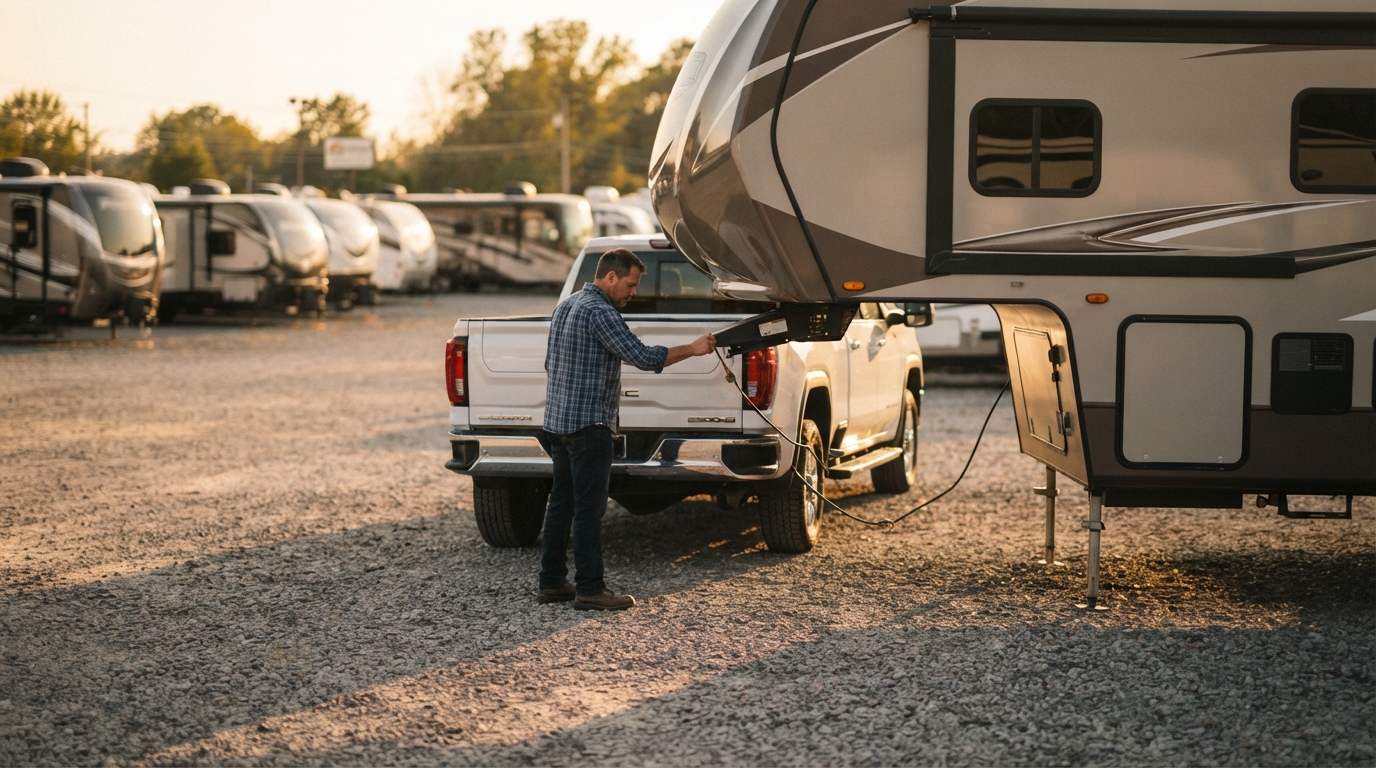
- A fifth wheel hitch mounts in the truck bed and uses a kingpin-and-jaw connection, giving a smoother ride for recreational towing.
- A gooseneck hitch uses a ball-and-coupler connection, usually handles higher weight limits, and leaves more open bed space.
- The right choice depends on what is being towed: RVs typically pair with fifth wheel setups, while livestock and equipment trailers favor gooseneck.
A Fifth Wheel hitch connects to a trailer through a kingpin and jaw mechanism mounted above the truck bed’s rear axle, while a gooseneck hitch relies on a ball-and-coupler connection fixed to the bed floor. The core distinction between these two towing systems comes down to how the trailer attaches, how much weight each can handle, and what type of load each is designed to carry. Understanding these differences matters for anyone shopping for a towable recreational vehicle or comparing trailer options before a purchase.
For drivers evaluating a large travel trailer, Liberty RV lists fifth wheels among its RV categories, alongside travel trailers and toy haulers.
How the Two Hitch Systems Actually Work
The mechanical connection is where fifth wheel and gooseneck setups diverge the most.
- Fifth wheel hitch : a large kingpin-and-skid-plate hitch that connects the trailer’s pin box to a saddle in the bed.
- Gooseneck hitch : a much smaller ball-and-coupler hitch that connects the trailer’s gooseneck arm to a ball mounted in the bed.
- Bed space impact: gooseneck hitches take up much less bed space than fifth wheel hitches.
This difference in hardware explains why the two systems are not simple substitutes for one another. The two systems are not interchangeable, and a fifth wheel trailer cannot be hooked to a gooseneck hitch without an adapter, and vice versa.
Towing Capacity and Ride Comparison
Weight capacity and road feel are the two factors most drivers weigh before choosing a setup.
|
Factor |
Fifth Wheel Hitch |
Gooseneck Hitch |
|
Typical towing capacity |
16,000 to 30,000 pounds |
Can exceed 30,000 pounds |
|
Ride quality |
Smoother, quieter, more stable towing |
Generally less stable through turns |
|
Bed usability when not towing |
Mostly blocked |
Almost fully usable |
|
Common use case |
Better for recreational towing |
Better for farming and commercial towing |
The weight gap is consistent across most manufacturer comparisons. Most gooseneck hitches have a greater towing capacity than 5th-wheel hitches by at least 3,000 pounds, and by as much as 10,000 pounds. Despite the lower ceiling, fifth wheel systems remain the standard for RVs because of ride comfort. 5th-wheel hitches tend to offer a smoother, more stable towing experience and tend to be quieter than gooseneck hitches in general.
Choosing Based on What Gets Towed
Matching the hitch to the trailer type prevents mismatched setups and safety issues on the road.
1. Recreational trailers and RVs – for recreational purposes, a fifth-wheel hitch would be suitable for towing large RVs.
2. Agricultural and livestock trailers – gooseneck hitches are often used for horse trailers or large agricultural equipment transport.
3. Adapter limitations – a dedicated fifth wheel hitch is the safer and more reliable option rather than relying on a conversion adapter for an RV.
Drivers researching towing regulations or vehicle weight ratings before a purchase can review guidance from the Federal Highway Administration, which outlines vehicle size and weight standards relevant to towing setups. In Topeka, KS, seasonal road conditions and highway grades can affect how a towing rig performs, making hitch type and stability a practical consideration before any long trip.
Based in USA, Liberty RV serves customers across Topeka, KS with inventory and purchase support for towable recreational vehicles. The company’s listed RV categories include fifth wheels and travel trailers, consistent with its focus on recreational towing rather than commercial or agricultural trailer sales.
Frequently Asked Questions
Can a gooseneck trailer be towed with a fifth wheel hitch? This is almost never recommended because the trailer’s gooseneck arm geometry was not designed to load a fifth wheel saddle, and side-to-side stability suffers.
Why do fifth wheel hitches cost more than gooseneck setups? Gooseneck hitches are less expensive, and compatible trailers tend to be less expensive than fifth wheel trailers, making the gooseneck the less expensive choice overall.
Is a fifth wheel hitch harder to install than a gooseneck? Installing a gooseneck hitch requires drilling into the truck bed, while a fifth wheel hitch needs a specialized undercarriage, so both require professional installation but through different methods.
A Note on Research and Next Steps
Reviewing towing capacity, hitch type, and bed space needs before comparing specific trailers helps narrow down which setup fits a given tow vehicle and travel style. Current inventory and specifications for Liberty RV are published for reference when comparing towable trailer options.