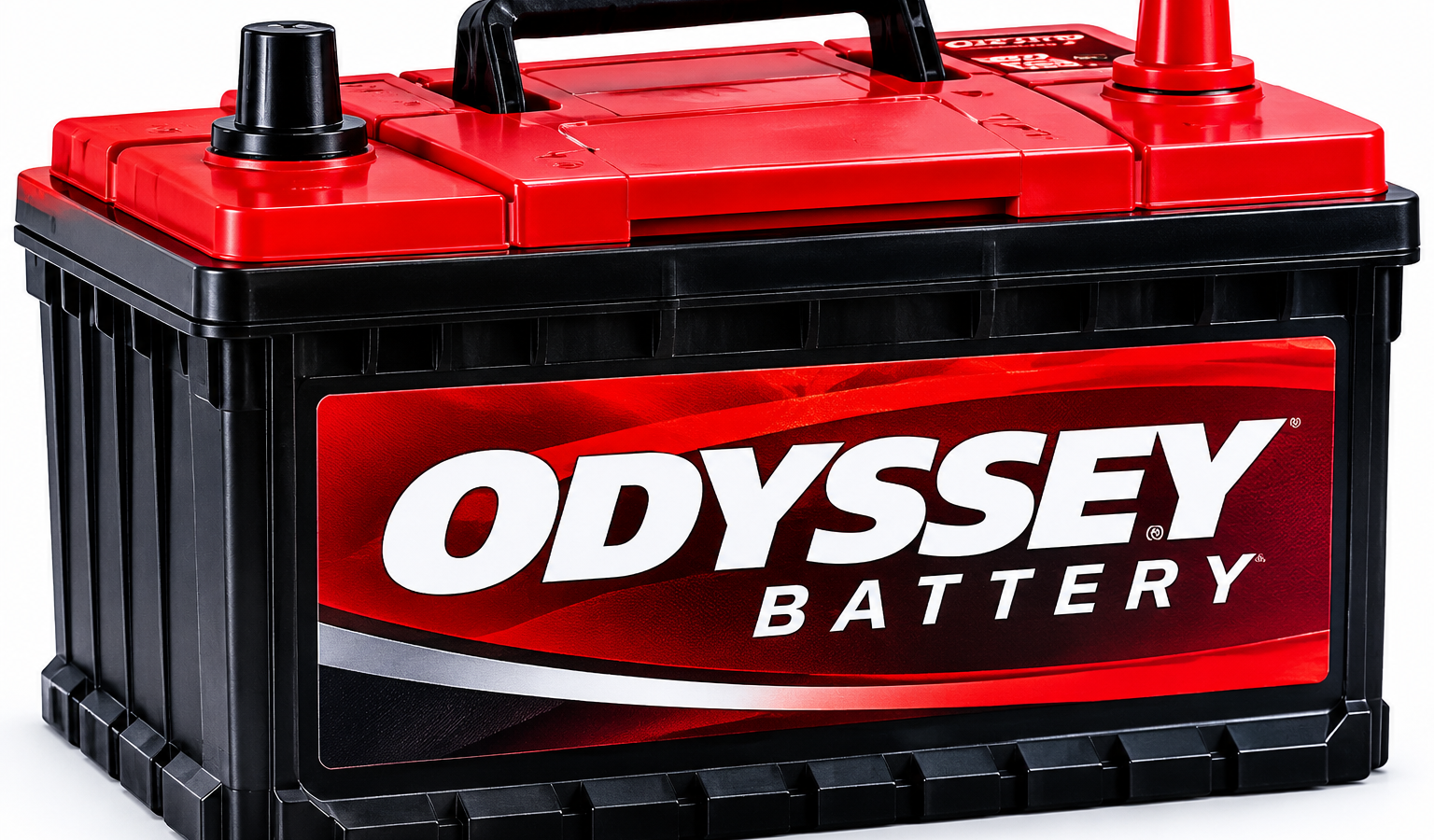
Bottom line:
- Odyssey Battery units use Absorbed Glass Mat (AGM) construction with Thin Plate Pure Lead plates, a design built for high cranking power and extended service life.
- These batteries are sealed, non-spillable, and rated for mounting in multiple orientations, making them suited to automotive, marine, and powersport applications.
- American Battery Corporation, based in Temecula, CA, serves customers across Vista, CA, for battery selection and replacement needs.
An Odyssey Battery is a sealed lead-acid battery built around Absorbed Glass Mat (AGM) separator material and thin, pure-lead plates rather than the lead-alloy grids found in conventional batteries. This construction is engineered to deliver stronger cranking performance and a longer working lifespan than standard flooded or spiral-wound batteries used in similar vehicles and equipment.
The technology behind these batteries combines two established approaches to lead-acid design. Odyssey batteries are manufactured using AGM Thin Plate Pure Lead (TPPL) technology, which the manufacturer states is built to deliver twice the power and three times the life of conventional AGM batteries, according to the manufacturer’s technical manual. The pure lead plates allow more plate surface area to fit inside the case compared to spiral-wound designs, which translates into higher power output and reserve capacity.
How AGM and Thin Plate Pure Lead Construction Work Together
Absorbed Glass Mat technology holds all of the battery’s electrolyte within a fiberglass mat separator instead of allowing it to move freely as a liquid. This sealed, non-spillable design means the battery can be mounted in nearly any position without leaking, a feature documented across multiple Odyssey product listings.
Thin Plate Pure Lead construction adds a second layer of performance:
- Plates made from 99.99 percent pure lead rather than lead-alloy, which supports higher conductivity
- More plates packed into the same case footprint, increasing available surface area for current flow
- Lower internal resistance, which supports faster recharge rates and stronger cold-weather cranking
Reserve capacity and cold cranking amps vary significantly by model and group size, so checking the specification sheet for the exact battery group is the only reliable way to confirm fitment for a given vehicle or system.
Comparing Odyssey Battery Technology to Conventional Options
The table below summarizes general differences between TPPL AGM construction and conventional flooded lead-acid batteries, based on manufacturer specifications.
| Feature | Odyssey AGM / TPPL | Conventional Flooded Battery |
| Electrolyte state | Absorbed into glass mat, sealed | Free-flowing liquid, vented |
| Mounting orientation | Multiple positions, non-spillable | Upright only |
| Recharge speed | Faster recharge efficiency per manufacturer data | Slower, standard recharge rates |
| Vibration resistance | Reinforced for high-shock use | Lower resistance to shock and vibration |
These distinctions matter most in applications with high electrical demand or exposure to vibration, such as marine, powersport, and commercial vehicle use, where battery placement and durability are ongoing practical concerns.
Maintenance and Selection Considerations for Vista, CA Drivers and Equipment Owners
Vista, CA experiences a coastal-influenced climate with warm summers, which can accelerate battery aging if charging voltage and storage temperature are not properly managed. Manufacturer guidance recommends float voltage near 13.6 volts for a 12-volt AGM battery at standard room temperature, and batteries stored below that temperature may need a freshening charge to avoid capacity loss.
Buyers evaluating a replacement battery should consider a few practical factors:
1. Confirm the correct battery group size and terminal type for the vehicle or equipment
2. Match cold cranking amps (CCA) and reserve capacity to the application’s electrical demand
3. Check the manufacturer’s recommended charging voltage range before connecting any charger
4. Store spare batteries at a stable, moderate temperature to limit self-discharge
Based in Temecula, CA, American Battery Corporation extends battery sales and support to customers throughout Vista, CA, covering automotive, marine, and powersport battery needs.
Frequently Asked Questions
What makes AGM batteries different from standard car batteries? AGM batteries seal electrolyte into a glass mat rather than leaving it as free liquid, which prevents spills and allows mounting in multiple orientations, unlike conventional flooded batteries that must remain upright.
How long do Thin Plate Pure Lead batteries typically last? Manufacturer specifications indicate TPPL AGM batteries are built for up to three times the service life of conventional AGM batteries, though actual lifespan depends on usage, charging practices, and climate conditions.
Can an AGM battery be mounted on its side? Many AGM battery models are built to be non-spillable and rated for mounting in various orientations, but the exact allowable positions depend on the specific model, so checking the battery’s datasheet is recommended.
Do AGM batteries need a special charger? AGM batteries generally require a charger capable of matching the manufacturer’s specified voltage range, since overcharging or undercharging can shorten battery life or cause damage.
Business Information
American Battery Corporation’s Google Business Profile lists battery sales and support services for automotive, marine, and powersport applications, with a base of operations in Temecula, CA.
Current listing information for American Battery Corporation is maintained online for reference by area residents.