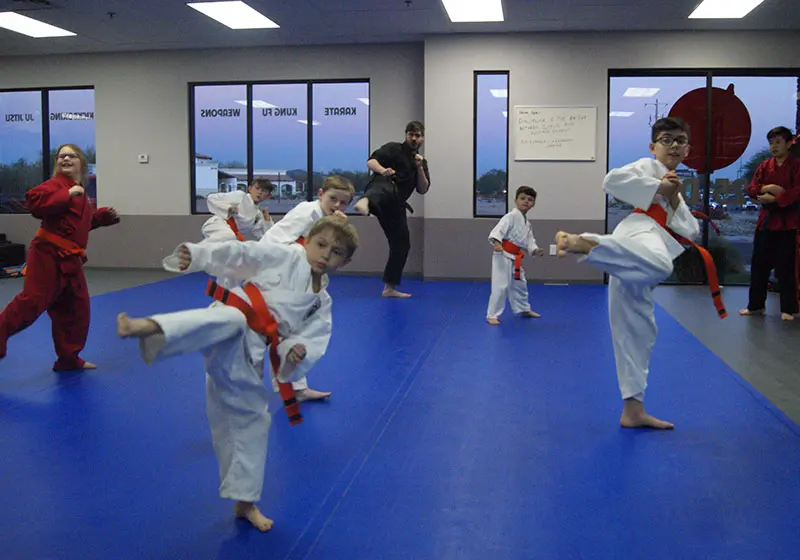
Consistent class attendance matters in martial arts because students learn through repeated instruction, guided practice, correction, and gradual reinforcement of skills. Regular participation helps students maintain continuity between lessons, remember previously introduced techniques, and build on earlier instruction instead of repeatedly trying to regain lost ground.
Martial arts progress rarely comes from one unusually productive class. It develops through a sequence of smaller learning experiences that connect over time.
For someone beginning Martial Arts Classes, this can be easy to overlook. A new student may naturally focus on individual techniques: a stance, movement, combination, defensive response, or exercise. Yet each lesson usually makes more sense when it is connected to what came before and what will be practiced next.
That is one reason attendance can play such an important role in the training process.
Why Does Regular Attendance Matter in Martial Arts?
Martial arts is cumulative.
Students often learn a basic concept before being asked to apply it in a more complicated way. A stance may support a movement. That movement may later become part of a combination. The combination may eventually require greater timing, balance, control, or awareness.
Missing one class does not erase a student’s progress. Life inevitably brings schedule conflicts, illnesses, work demands, family responsibilities, and other interruptions.
The larger concern is a repeated pattern of inconsistent attendance.
When long gaps become common, students may return needing additional time to remember material that was previously becoming familiar. That can make new instruction harder to absorb because attention is divided between recalling older material and understanding what is currently being taught.
Regular attendance helps preserve that learning continuity.
How Does Repetition Turn Instruction Into Usable Skill?
Hearing an explanation once is different from being able to perform a movement with control.
A student might understand what an instructor demonstrates but still need many opportunities to coordinate the movement physically. Small details such as posture, balance, foot position, timing, distance, or hand placement can require continued practice.
This is where repetition matters.
During Martial Arts Lessons, students may encounter the same foundational concepts repeatedly while applying them in slightly different situations. That repetition does not necessarily mean doing an identical exercise endlessly. It can mean returning to a familiar skill and gradually refining it.
For example, a beginner may initially concentrate almost entirely on remembering where to place their feet. After that becomes more familiar, they can pay greater attention to body position. Later, the instructor may ask them to consider timing or control.
The technique did not suddenly change. The student’s capacity to notice and manage more parts of it did.
Consistent attendance creates more opportunities for that progression to occur.
What Happens When Martial Arts Training Becomes Irregular?
Occasional missed classes are normal. Irregular training becomes more challenging when interruptions are frequent enough to break the learning rhythm.
A student returning after a long gap may experience several things at once:
- Familiar movements may feel less automatic.
- Sequences may be harder to recall.
- Conditioning may feel different.
- Recent class material may be unfamiliar.
- More mental effort may be required to follow instruction.
- The student may become frustrated because previously learned skills feel less comfortable.
None of these reactions mean the student has failed or should stop training.
They simply illustrate why continuity can be useful.
Someone who attends regularly is more likely to encounter concepts while previous instruction is still relatively fresh. The next lesson can then reinforce or extend what was already practiced instead of requiring a substantial review.
Why Is Instructor Feedback More Useful When Training Is Consistent?
Martial arts instruction is not only about receiving information. It also involves receiving feedback.
An instructor may notice that a student’s stance is improving but that their balance changes during a certain movement. At another class, the instructor may observe whether the correction has carried over.
That ongoing feedback creates a learning cycle:
- The student practices a skill.
- The instructor observes it.
- A correction or adjustment is provided.
- The student practices again.
- The instructor can evaluate the change.
Regular attendance gives that cycle more opportunities to continue.
With large gaps between sessions, the instructor may need to revisit earlier corrections before moving forward. With greater continuity, adjustments can become increasingly specific as the student develops.
This is relevant for beginners as well as more experienced students. Early corrections can help establish stronger fundamentals, while later feedback can address increasingly subtle details.
Does Consistency Matter More Than Training Intensely Once in a While?
For most students, a sustainable routine is more useful than occasional bursts of enthusiasm followed by long periods away.
A person may feel motivated enough to practice extensively for a few days. But martial arts development is generally better viewed as an ongoing learning process rather than a short-term project.
Consistent participation gives students time to absorb instruction and return to it repeatedly.
It also reduces the pressure to master everything immediately.
A student does not need to perfect every movement in a single lesson. They can work on one detail, return during the next class, receive another correction, and continue developing from there.
This approach makes room for gradual improvement.
How Can Attendance Help Beginners Feel Less Overwhelmed?
The first few weeks of Karate Training can involve a great deal of unfamiliar information.
Students may be learning new terminology, class etiquette, basic movements, stance positions, combinations, and expectations at the same time. It is normal for some of that information to feel unfamiliar at first.
Regular participation helps reduce that novelty.
The class environment becomes more predictable. Common instructions become easier to recognize. Movements that once required considerable thought begin to feel more familiar.
This can free up attention for learning new material.
Imagine a student beginning their first week and needing to consciously think about where to stand, how to position their feet, and what an instructor means by a particular direction. After repeated exposure, those basic elements may require less mental effort.
That leaves more attention available for the next layer of learning.
Why Does Class Attendance Support Better Training Habits?
Showing up consistently is itself a useful habit.
Students who make training part of their regular schedule are less dependent on whether they happen to feel motivated on a particular day.
That distinction matters because motivation naturally changes.
Some classes will feel exciting. Others may be difficult. A student might struggle with a new movement or have a day when concentration does not come as easily.
A regular routine gives training a dependable place in the week despite those fluctuations.
This does not mean students should ignore illness, injury, recovery needs, or legitimate personal responsibilities. Consistency should be sustainable, not rigid.
The goal is to create a realistic pattern of participation that can be maintained over time.
How Does Regular Practice Affect Karate Lessons?
In Karate Lessons, students often work with skills that depend on one another.
Balance supports controlled movement. Positioning affects technique. Timing becomes more meaningful once a student can perform the underlying movement reliably.
Regular training helps students revisit those connections.
Instead of treating each class as an isolated event, the student begins to recognize how foundational principles appear repeatedly across different exercises.
This is an important part of learning. A student may initially think of two techniques as completely separate. With continued instruction, they may begin noticing that both depend on similar principles of posture, movement, control, or distance.
Those connections become easier to recognize when training occurs regularly enough for concepts to remain familiar.
What Role Does Consistency Play for Adult Students?
Adults often have a different challenge than younger students: scheduling.
Work, family commitments, commuting, household responsibilities, and changing routines can all compete for time. Adults may also be more likely to postpone a class because they believe they can simply make up for it later.
A useful approach is to treat martial arts as a scheduled commitment rather than something that happens only when an empty evening appears.
People exploring Martial Arts Classes for adults can benefit from considering whether the available schedule fits realistically into their lives before establishing a training routine.
Consistency does not require perfection.
Someone who occasionally misses class because of work or family responsibilities can still maintain an overall regular pattern. What matters is returning to the routine rather than allowing one missed lesson to turn into several weeks away.
Can Consistent Training Help Students Notice Their Own Progress?
Martial arts progress can sometimes be difficult to recognize from one day to the next.
Changes often happen gradually.
A technique may feel slightly more controlled. A sequence may require less conscious thought. A student may remember an instruction more quickly or recover from a mistake without becoming as distracted.
Because these changes are incremental, students may overlook them.
Regular training provides more points of comparison.
Someone attending consistently can remember when a movement was unfamiliar and later notice that it has become routine. They can recognize that an exercise requiring considerable concentration several weeks ago now feels more manageable.
That perspective can make progress easier to appreciate.
How Do Martial Arts Principles Relate to Consistent Training?
The mental side of training can influence the way students approach attendance and practice.
At Atkinson’s Martial Arts, instructors integrate the Black Belt Principles of Honesty, Courtesy, Integrity, Perseverance, and a positive attitude into students’ journeys.
Those ideas have practical relevance to consistency.
Perseverance may mean continuing to work on something that does not come easily. Integrity can involve taking responsibility for one’s own effort. A positive attitude can help a student return to a difficult technique without treating an imperfect attempt as failure.
These principles do not replace physical instruction. Instead, they can provide a framework for how students approach the learning process both inside and outside the dojo.
What If Someone Has Already Missed Several Classes?
The simplest answer is usually to return.
Students sometimes make an interruption larger than it needs to be because they worry that they have fallen too far behind.
That concern can create another delay.
After time away, it may take a few classes for movements and routines to feel familiar again. That is normal. The student can focus on listening carefully, reviewing fundamentals, and accepting corrections rather than expecting to resume at exactly the same level of comfort they had before the break.
Returning sooner allows the rebuilding process to begin.
How Can Students Make Attendance More Sustainable?
Consistency is easier when the routine fits real life.
Students can consider several practical strategies:
Choose realistic training times
A class that regularly conflicts with work, school, or family obligations will be difficult to maintain.
Prepare before class days
Keeping necessary clothing or equipment organized can reduce small barriers that make skipping easier.
Avoid an all-or-nothing mindset
Missing one session does not mean the routine has failed. Resume at the next reasonable opportunity.
Focus on the next lesson
Long-term goals can be motivating, but progress still happens one class at a time.
Ask instructors when something feels unclear
If time away has made certain material confusing, asking for clarification can help a student reconnect with the training sequence.
These strategies are simple, but sustainable routines often depend on simple habits.
Consistency Creates Continuity in Martial Arts Learning
Karate Martial Arts training is not defined by how much a student learns in one day. Skills develop through instruction, repetition, feedback, correction, and continued practice over time.
Regular attendance helps preserve the connection between those experiences.
Students can remember previous material more easily, apply instructor feedback sooner, recognize how skills relate to one another, and gradually become more comfortable with increasingly complex instruction.
Perfect attendance is not the goal. Real life will sometimes interrupt training.
What matters is establishing a realistic pattern, returning after interruptions, and giving the learning process enough continuity to work.
About Atkinson’s Martial Arts
Atkinson’s Martial Arts serves Peoria, Arizona, with martial arts programs for kids, teens, and adults, with instruction that emphasizes martial arts development, practical self-defense, and personal growth. Chief Instructor Sensei Andrew Gunn is listed by the school as a fifth-degree black belt in Kenpo Karate and a black sash in Chuan-Fa; those interested in the Peoria dojo can find their location on Google Maps or call 623-825-3656 for information about training.